


Table of Contents
- Causes of Hair Thinning in Women: What Is Actually Driving Yours
- Hair Thinning Solutions for Women: Matching the Fix to the Cause
- Dermatologist for Hair Loss: When to Book and What to Expect
- Topical Minoxidil for Women: How It Works and What to Expect
- Hair Fibres for Thinning Hair: Instant Coverage That Stays Put
- Hair Thinning Solutions for Women: Treatment Timelines and Realistic Outcomes
- Conclusion
- Frequently Asked Questions
Last Updated: October 6, 2026
Causes of Hair Thinning in Women: What Is Actually Driving Yours
Hair thinning in women rarely has a single cause, which is exactly why so many women waste months treating the wrong one. At BOOST N BLEND™, we hear the same frustration constantly: a doctor shrugs, a shampoo fails, and the shedding continues. The fix starts with identifying which of three broad categories you fall into.
Hormonal Hair Thinning: Menopause, Postpartum and Androgenetic Alopecia
Hormonal hair thinning is the most common driver of female hair loss, and it is also the most misunderstood. Female pattern hair loss, known clinically as androgenetic alopecia, shows up as a widening part and a thinner crown rather than a receding hairline. Menopause accelerates it because falling oestrogen leaves follicle-shrinking androgens relatively unopposed. Postpartum shedding is a different mechanism entirely: it is a temporary surge of hair shedding triggered by the sudden hormone drop after birth, and it usually settles on its own within months.

Temporary Hair Thinning and Shedding: Telogen Effluvium, Illness and Stress
Telogen effluvium is a temporary form of hair shedding triggered by a shock to the system, whether that is illness, surgery, significant weight loss, or sustained stress. The shedding typically appears weeks after the trigger, not during it, which is why so many women cannot connect cause to effect. The reassuring news: this type of hair shedding is usually reversible once the trigger resolves.
Hair-Care Practices That Cause Traction and Breakage
Tight hairstyles, frequent heat styling, and harsh chemical treatments can all cause traction and breakage that mimics genetic thinning. A wide-tooth comb, gentler styling habits, and a break from tension styles can stop the damage from compounding.
Hair Thinning Solutions for Women: Matching the Fix to the Cause
The right hair thinning solutions for women depend entirely on which cause you are dealing with. Treating a hormonal pattern with a volumising shampoo, or treating temporary shedding with a prescription topical, wastes time and money. Use the decision tree below to narrow it down, then match the pathway to the cause.
A Practical Diagnostic Decision Tree
Work through these questions in order. This is a guide to what to raise with a clinician, not a substitute for diagnosis.
- Did the shedding start suddenly within the last 6 months, after illness, birth, surgery, significant weight loss or major stress? → Likely telogen effluvium. Focus on scalp health and allow the cycle to correct.
- Is your part widening slowly over years, with a thinner crown and preserved frontal hairline? → Likely androgenetic alopecia (female pattern hair loss). This needs cause-specific treatment plus cosmetic coverage.
- Did it begin around perimenopause or menopause, or alongside a change in hormonal contraception? → Likely hormonal hair thinning. Combine scalp support with a concealer for immediate confidence.
Cause-Specific Treatment Pathways
For temporary shedding, the priority is nourishing the scalp and follicles while the cycle corrects itself. Our Revival Tonic Spray feeds the scalp with rosemary, saw palmetto, caffeine and pea sprout extract, while our Scalp Massaging Brush increases blood flow to the follicle base. For breakage, switch to a gentle routine like our Growth Boost Shampoo and Conditioner, which is silicone-free and free from sulphates.

Evidence Strength at a Glance
Not every option carries the same weight of evidence. The table below separates what is well supported from what is largely cosmetic or supportive.
|
Option |
Evidence Strength |
Likely Benefit |
Main Limitations |
|---|---|---|---|
|
Topical minoxidil |
Strong for female pattern loss |
Improved density over months |
Ongoing use, irritation, not for pregnancy |
|
Oral prescription medication |
Moderate to strong in selected patients |
Density in suitable candidates |
Prescription only, side effects, not for pregnancy |
|
Nutritional correction |
Strong where a deficiency is confirmed |
Reversal of deficiency-related shedding |
No benefit if levels are normal |
|
Low-level light therapy |
Mixed |
Possible modest density support |
Cost, time, inconsistent results |
|
Cosmetic fibres and concealers |
Not a treatment |
Immediate visible coverage |
No effect on hair growth |
|
Supplements (unconfirmed deficiency) |
Weak |
Unclear |
Cost, interactions, no guarantee |
Cost and Access Considerations
Costs fall into two very different buckets. Ongoing medications are a recurring monthly expense that continues for as long as you want to keep the benefit, whereas procedures and in-clinic treatments are usually a larger upfront cost with no guarantee of result. Cosmetic concealers sit in the low, repeat-purchase category and deliver immediate coverage regardless of cause.
|
Cause |
First Move |
Realistic Timeline |
|---|---|---|
|
Telogen effluvium |
Scalp nourishment, reduce stress |
3-6 months |
|
Androgenetic alopecia |
Medical review plus daily coverage |
Ongoing management |
|
Hormonal (menopause) |
Scalp support plus concealer |
Ongoing management |
|
Traction or breakage |
Change styling, gentle washing |
2-4 months |
|
Nutritional deficiency |
Blood tests, correct the deficiency |
3-6 months after correction |
|
Inflammatory scalp condition |
Medical assessment first |
Varies with diagnosis |
Dermatologist for Hair Loss: When to Book and What to Expect
Book a dermatologist for hair loss when the shedding is sudden, patchy, accompanied by scalp pain or scaling, or when you can see a widening part that has progressed over more than six months. A dermatologist can confirm a hair loss diagnosis, check for underlying conditions such as thyroid issues or iron deficiency, and prescribe treatment options that are not available over the counter.
Topical Minoxidil for Women: How It Works and What to Expect
Topical minoxidil for women is an over-the-counter treatment applied directly to the scalp. It is thought to work by prolonging the growth (anagen) phase of the hair cycle, increasing follicle size and extending the time each hair spends actively growing. That mechanism explains both its strength and its limits: it can improve density on follicles that are still active, but it is far less effective on areas that have been bare for years, where the follicle may have stopped producing visible hair.
What Results Actually Look Like
Most practitioners find that topical minoxidil takes at least four to six months of consistent use before a change in density is noticeable, and some women need closer to twelve months to judge whether it is working. Progress is usually measured by comparison photographs of the same part and crown, taken in similar lighting, rather than by how the hair feels day to day.
Safety, Contraindications and Pregnancy
Topical minoxidil is not suitable during pregnancy or breastfeeding, and it should not be started if you are trying to conceive without first speaking to your doctor or pharmacist. It is also generally avoided where there is an inflamed, broken or infected scalp, because the alcohol base can sting and absorption may be unpredictable. Some women develop contact irritation, flaking or itching from the propylene glycol or alcohol in the vehicle; a foam formulation is sometimes tolerated better than a liquid.
How It Compares With Oral Options
Oral medications for hair loss are prescription-only and are generally considered when topical treatment is not tolerated, not effective after a fair trial, or when the pattern is more extensive. They carry a different risk profile, including hormonal and systemic side effects, and are not appropriate for everyone, particularly women who are pregnant, breastfeeding or planning pregnancy.
Practical Use
Apply to a dry scalp, not wet hair, and follow the label rather than doubling up after a missed dose. Wash your hands afterwards, and allow the product to dry before styling or applying hair fibres. Because results depend on consistency, pair the treatment with a simple tracking habit: the same three photos, same light, same angles, once a month.
Hair Fibres for Thinning Hair: Instant Coverage That Stays Put
Hair fibres for thinning hair are a cosmetic concealer, not a treatment, and that is precisely their strength: they deliver immediate results while slower treatments do their work.
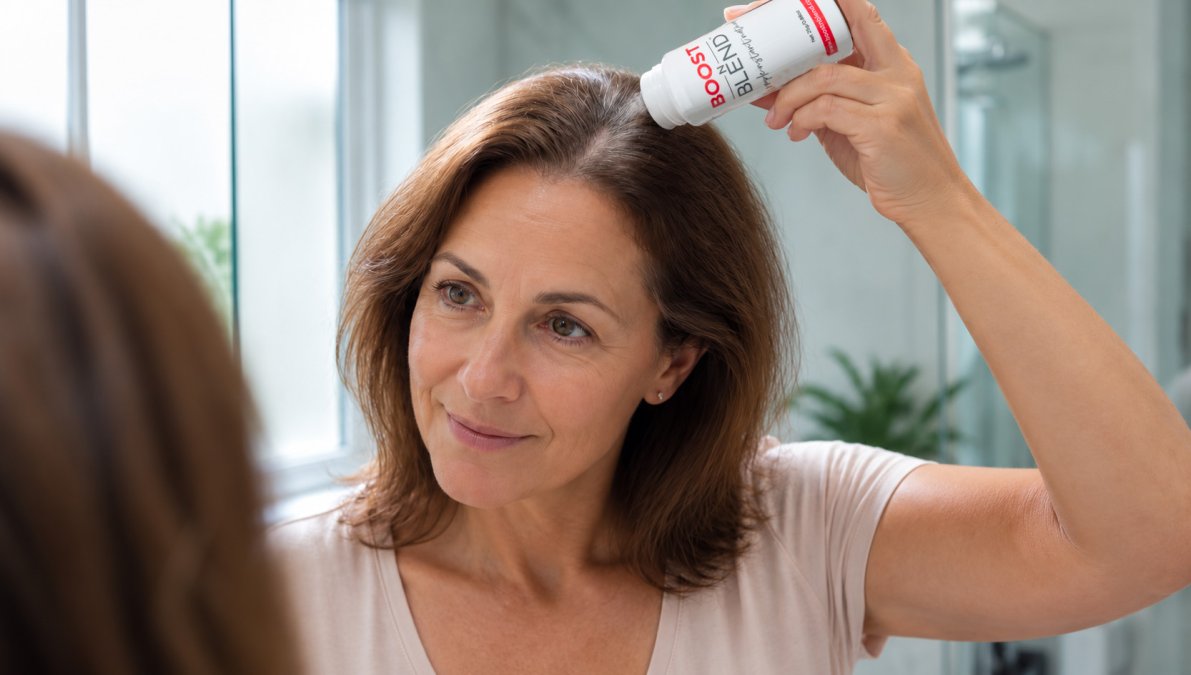
Our Female Hair Fibres are made from natural, vegan-friendly cotton and are designed not to clog hair follicles, so they are safe to use every day. For women who want more control during application, the Hair Fibres + Applicator bundle pairs the 25g bottle with a pump applicator.
How Cotton Fibres Compare With Other Concealer Options
Most concealers on the market rely on keratin or synthetic bases. Keratin is often animal-derived, which rules it out for vegan buyers, and heavier formulations can feel gritty or flake under sweat. Cotton fibres are lighter, sit closer to the natural hair colour, and hold up better through an active day. A common mistake is applying too much in one spot; build coverage in thin layers instead.
Hair Thinning Solutions for Women: Treatment Timelines and Realistic Outcomes
Realistic timelines matter more than promises. Temporary hair shedding from telogen effluvium usually resolves within three to six months once the trigger passes. Medical treatments such as topical minoxidil can take four to six months before you notice a change in hair density, and results fade if you stop. Cosmetic concealers like hair fibres work the moment you apply them, which is why we recommend pairing immediate coverage with a longer-term plan.
Conclusion
Waiting for the "right" moment to address thinning hair usually means losing more density in the meantime. BOOST N BLEND™ was developed by Australian Registered Nurse Bambi Staveley specifically for women, using natural, vegan-friendly cotton fibres that make each hair shaft appear up to 10 times thicker and conceal visible scalp without clogging follicles. Pair the fibres with our scalp-nourishing Revival Tonic Spray and gentle Volume Boost Shampoo for a routine that supports your hair while giving you instant confidence.

Frequently Asked Questions
What happens when you stop using topical minoxidil?
Once you stop applying topical minoxidil, any hair regrowth it supported usually sheds within a few months and your hair returns to its previous pattern of thinning. Minoxidil needs continued daily use to maintain results, which is why many women pair it with cosmetic cover such as hair fibres for days when they want immediate volume without waiting on a growth cycle.
Can hormonal changes cause hair thinning in women?
Yes. Menopause, postpartum hormone shifts and conditions affecting androgen levels are common causes of hair thinning in women. Androgenetic alopecia, also called female pattern hair loss, is driven by hormones acting on genetically sensitive hair follicles, while the shedding after childbirth is usually temporary hair thinning that resolves as hormones settle. A dermatologist or trichologist can confirm which pattern you have.
How can women make thinning hair look fuller straight away?
The fastest route is a cosmetic concealer. Cotton hair fibres cling to each hair shaft and can make the finest hair look up to ten times thicker, covering visible scalp in seconds. Boost N Blend Female Hair Fibres are vegan, designed by women for female hair loss, and safe for daily use, so you can add volume before work or an event without waiting months for a growth treatment to show results.
When should women seek professional advice about hair loss?
Book a dermatologist for hair loss if you notice sudden or patchy shedding, scalp pain, itching or scaling, or thinning that continues for more than six months. A dermatologist or trichologist can run blood tests, examine your scalp and confirm whether you have androgenetic alopecia, telogen effluvium or another hair disorder. Early diagnosis widens your treatment options and helps you avoid wasting money on products that do not match your cause.
Is it safe to use hair fibres every day on a sensitive scalp?
Cotton-based hair fibres are formulated to sit on the hair shaft rather than block the follicle, so daily use is generally well tolerated. Boost N Blend fibres are vegan, free from animal keratin and designed by an Australian Registered Nurse specifically for women with thinning hair. If your scalp is reactive, patch test first and keep your scalp clean with a gentle, sulphate-free shampoo such as Boost & Be Volume Boost Shampoo.
How long does one bottle of hair fibres last?
A 25g bottle of Boost N Blend Female Hair Fibres is marketed as roughly a three-month supply with daily use, which works out to around 60 cents a day at the $55 price. The Hair Fibres + Applicator pack at $75 adds a pump applicator for more precise placement along the hairline and part, which many women find stretches the product further.


